Welcome to
The Hive
At The Hive, we bring together a dynamic community of HR leaders, compliance experts, technologists, and thinkers who care about getting identity, hiring, and trust right.
Expect practical insights, bold ideas, and real-world stories from across the employment and identity landscape. Not just from ZipID, but from people like you. Because when we swarm together, we build smarter.

Identity Fraud Is No Longer Just an Immigration Problem—And HR Is on the Front Line
ZipID founder and 25-year identity intelligence veteran Janice Kephart joins Catalyst Chats to explain why the I-9 is now your first line of defense against deep fakes, stolen identities, and AI-enabled hiring fraud—and why E-Verify alone isn't enough.

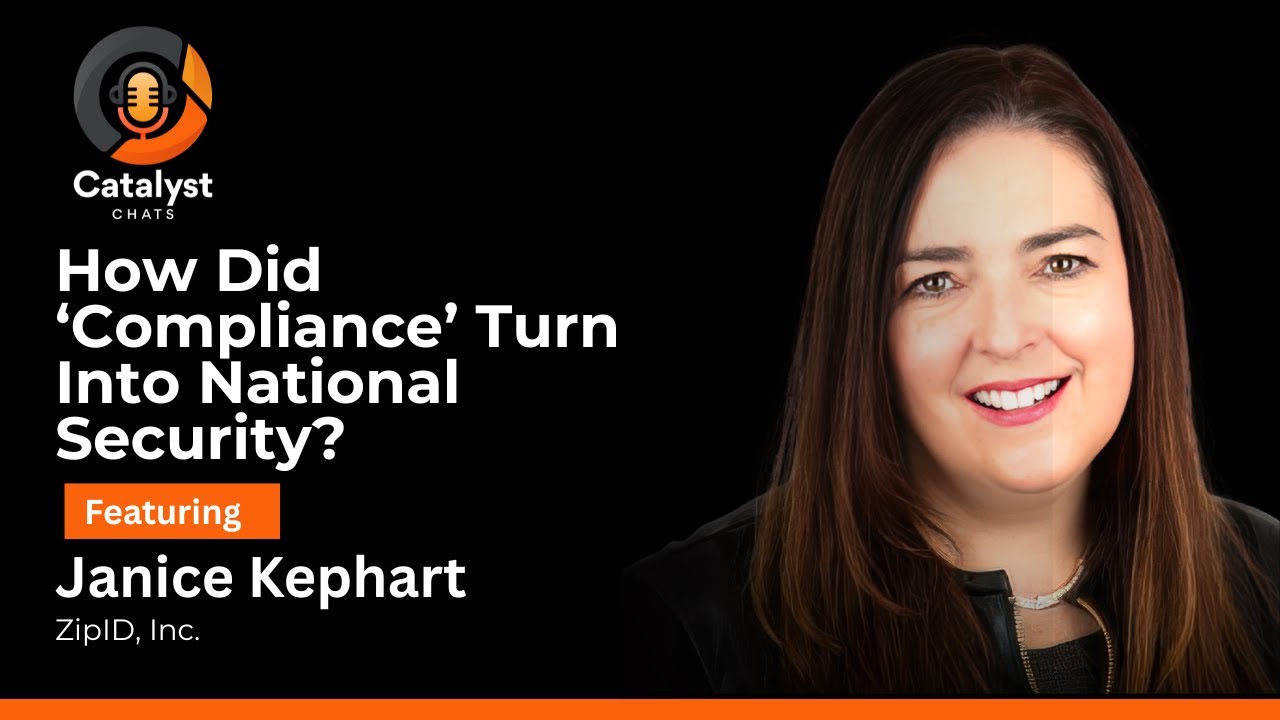
Janice Kephart, CEO of ZipID and 25-year identity intelligence veteran, joins Lindsey Hammer on Catalyst Chats to explain why theI-9 has become your most underestimated fraud-prevention tool.
By Janice Kephart · CEO & Founder, ZipID · Former 9/11 Commission Staff · Identity Law & PolicyExpert
Listen to the full episode on Catalyst Chats: catalyst-chats-podcast.lovable.app
When Lindsey Hammer invited Janice Kephart onto Catalyst Chats, she expected a conversation about I-9 compliance. What she got was a masterclass in how 25 years of national security, immigration law, and identity policy converge in asingle three-day hiring window—and why every HR leader needs to start paying attention.
From the 9/11 Commission to the Hiring Queue
Janice Kephart’s path to founding ZipID runs through the 9/11 Commission, where she served on the immigration team tasked with understanding how 19 hijackers entered—and stayed in—the United States long enough to execute an attack. Her conclusion shaped two decades of federal policy: identity failure was the root cause. Biometrics, trusted traveler systems, the Real ID Act, and the I-9’sE-Verify program all trace directly back to recommendations that came out of that work.
“If we had understood the identity of these people and the intelligence associated with them, 9/11 wouldn’t have happened. If we had been able to keep them out of the country, they would have never been able to do anything inside the country.”
— Janice Kephart, on lessons from the 9/11 Commission
That same analytical lens—stop fraud at the gate before it enters—is what she brought to ZipID five years ago. The problem she set out to solve: the I-9 requires every employer in America to verify both identity and work authorization, but gives them no reliable tool to actually do it.
What the I-9 Actually Requires (and Why It’s So Hard)
The Form I-9 is mandatory for every new hire in the United States—approximately 68 million last year alone. Employers have a three-day window from an employee’s first day of work to complete it. Miss a field, miss the deadline, or accept the wrong document, and each form carries a civil fine that can now exceed $2,700. Multiply that by a workforce of hundreds and the exposure is staggering.
~ 68M: New hires per year requiring an I-9
~ 500+: Legitimate ID combinations accepted
~ >$2,700: Maximum fine per form
~ 30%: Human accuracy matching face to ID
“There are over 500 legitimate ID combinations, because every state produces about 17 different varieties. There’s no way employers and HR folks are primed to identify fraud. No person can do face recognition other than when you know somebody—you have about a 30% chance of getting it right.”
— Janice Kephart
That cognitive gap—an HR professional confronting a stack of documents they were never trained to authenticate—is exactly where fraud enters. And the landscape of who commits that fraud, and why, has shifted dramatically.
Identity Fraud Has Changed. Has Your Hiring Process?
The dominant narrative around I-9 fraud has historically focused on undocumented workers in industries like construction, food processing, and agriculture. That narrative is now dangerously incomplete. Janice walked Lindsey through a threat picture that spans every sector and every pay grade.
DEEP FAKES AND REMOTE IMPERSONATION
With remote hiring now permanent for millions of roles, a bad actor can mask their face and voice in a video interview using AI-generated overlays. The Department of Justice prosecuted a case last year involving an identity theft ring of three American women who sold thousands of stolen U.S. identities to overseas operatives, who then showed up as “American employees” on their first remote day of work—many of them applying as senior software developers with access to proprietary systems.
“We now have problems with deep fakes—a person impersonating somebody else with a fake identity on a video conference. We’ve already had the Department of Justice prosecute an identity theft ring where people masking their face and masking their voice were pretending to be American when in fact they were Russian or North Korean.”
— Janice Kephart
SIX MILLION DEAD IDENTITIES IN ACTIVE USE
Social Security number theft from deceased individuals accounts for roughly six million instances of workplace identity fraud today. Because E-Verify only cross-checks the name attached to a Social Security number—not the document itself—a fraudulent identity built on a deceased person’s number routinely clears the system without a flag.
THE DETERRENCE EFFECT
One of the most practical insights Janice shared draws directly from her counterterrorism background: visible security deters fraud even before verification begins.
“Even a terrorist, like any type of criminal, always wants the easiest route. If it’s hard and they think somebody might catch them, they’re much less likely to do it. Even having a solution like ZipID in place—just telling them we’re going to take a selfie, we’re going to take a photo of your ID—that could be enough for them to turn around and run. There is a huge deterrence effect to having security in place.”
— Janice Kephart
Why E-Verify Isn’t Enough
Janice was candid about E-Verify—a program she was an early and vocal proponent of,testifying before Congress in its favor. Her assessment today is direct:employers are being given a false sense of security.
■ THE E-VERIFY GAP
• Driver’s licenses represent roughly 70% of E-Verify traffic. State license checks were offline for an extended period and, per Janice’s experience inside the government, are still not reliably verified against state DMV databases.
• U.S. passports, another 20% of traffic, used to be checked against State Department issuance records. That check is no longer consistently performed; only the photograph is compared—not the document fields.
• Stolen Social Security numbers belonging to deceased individuals pass through E-Verify without triggering a flag, because only the name-SSN pairing is checked—not actual identity.
“E-Verify is duping employers into thinking that person is authorized to work and that their identity is who they say they are—when in fact it’s not doing that at all. The only identity information they actually check is the social security number and the name attributed to it. If you’ve acquired one of the six million dead people’s IDs on the black market, that’s going to make it through. No problem.”
— Janice Kephart
What ZipID Does Differently
ZipID was built to close the gap between what the I-9 requires and what employers can realistically do. The workflow is designed to take less than three to five minutes for an employee and five to eight minutes for the employer—with no identity expertise required on either end.
HOW IT WORKS
The employer sends an invitation from their dashboard. The employee receives it from a recognizable sender (their employer’s email), creates a secure portal account, and completes section one. ZipID’s AI-powered optical character recognition reads the identity document and auto-populates all I-9 fields—the employee simply reviews and confirms. A selfie is captured and returned alongside the document image.
On the employer side, ZipID runs face recognition against the document photo and returns a confidence score with guidance on how to interpret it. Risk flags are generated automatically: if, for example, the IP address of the selfie differs from the IP address of the document upload, the reviewer is alerted to ask follow-up questions—not as a denial, but as a prompt for due diligence.
“Our optical reader tool will not read the ID if it determines it’s fake. It just won’t read it, and it will say to use something else. And then the face recognition gives you a confidence score on the match and tells you what to do with that confidence score.”
— Janice Kephart
DEEP FAKE DETECTION IN THE FIELD, TODAY
For employers currently using E-Verify’s video conference requirement, Janice shared a low-tech countermeasure: ask the candidate to hold up their ID to the camera. AI face-mask overlays often cannot sustain the overlay when an object interrupts the frame, making the real face visible behind the mask. It costs nothing and takes seconds.
PRIVACY AND SECURITY ARCHITECTURE
No identity information transacts outside ZipID’s encrypted AWS enclave. There is no email transmission of document images. Every company and every individual gets a separate encrypted folder. Wet digital signatures with metadata are required on both sections, satisfying ICE’s documentation standards.Audit-ready activity logs show every user action, timestamped, across allocations—critical protection for employers who need to demonstrate good-faith compliance in an enforcement action.
The Workforce Trends Shaping the Compliance Conversation
The conversation between Janice and Lindsey extended well beyond the I-9 itself into the HR trends accelerating identity risk: remote work permanence,AI-generated fake applicants, and the gig economy’s frictionless onboarding expectations.
Gartner projected earlier this year that by 2028, one in four job applicants may present fraudulent credentials—whether a fabricated resume, a stolen identity, or an AI-generated persona. That figure reframes the I-9 from a compliance checkbox into a first-line security control. Janice argues HR leaders need to make that mental shift now.
“HR deals with identity on a daily basis, but they’re now going to have to be a bit of an investigator, too. You cannot assume anymore that the person before you and the resume you have is legitimate. Gartner reported that by 2028, one in four job applicants will be fake.”
— Janice Kephart
Lindsey raised a tension that resonates for HR leaders caught between compliance burden and employee experience: the same technology meant to protect employers can feel like surveillance to candidates navigating a world of scam texts and phishing emails. Janice’s response points to ZipID’s design philosophy: because the invite arrives from the employer’s own email and routes directly to a branded portal, the process feels like onboarding—not interrogation.
“The employee using ZipID is having their identity protected, not just being scrutinized. They’re telling the employer: this is who I am. That’s where you’re building trust. So you’re creating an onboarding experience, plus making it so they don’t have to understand anything. We just ask questions, you fill it in, and that’s it.”
— Janice Kephart
What’s Coming for ZipID
The current product automates the full I-9 workflow with OCR, face recognition, risk flagging, E-Verify toggle, multi-location audit logging, and timed compliance notifications. On the roadmap: a native video conference tool withbuilt-in anti-spoofing, anti-deep-fake, and anti-morphing detection—drawing onJanice’s deep relationships in the biometrics vendor community built over two decades in federal identity programs.
On the partnership front, ZipID is fielding serious interest from applicant tracking systems and background check companies, both of whom see a differentiated I-9 and identity verification layer as a gap in their current offerings. The longer-term goal is integrations with HRIS platforms likeWorkday and BambooHR, and direct relationships with PEOs and multi-site employers in construction, food processing, financial services, and high-tech—the sectors where identity fraud risk is either already documented or rapidly emerging.
Ready to see how ZipID works? View pricing
ABOUT THE HOST
Lindsey Waddell Hammer
Lindsey Hammer is the founder of CatalystAI Solutions, an advisory practice focused on HR operations, AI-enabled workforce strategy, and the people side of compliance. A former Amazon talent leader who scaled hiring across high-volume, global operations, she advises HR companies on marketing, go-to-market strategy, and partnership development. On her Catalyst Chats podcast, she talks with the founders and operators reshaping how work gets done—from compliance technology to workforce AI.
Listen to the Catalyst Chats episode with Janice →
Start the Conversation
If your organization is auditing its I-9 posture, navigating a worksite enforcement action, or simply trying to understand what identity verification should look like in an era of remote hiring and generative AI, Janice welcomes the dialogue.
Connect on LinkedIn: linkedin.com/in/janicekephart
ExploreZipID: zipidapp.com
Listen to the full episode: catalyst-chats-podcast.lovable.app

Frequently Asked Questions
Is ZipID ICE-compliant I-9 software?
Yes. ZipID is designed to satisfy all five federal electronic I-9 system requirements under 8 CFR § 274a.2 — including compliant audit trails, electronic signature protocols, and secure storage standards. It is specifically designed to meet the March 2026 ICE reclassification that elevated common errors to substantive violations.
As of January 2025, I-9 paperwork violations carry fines of $288 to $2,861 per form under 8 CFR § 274a.10(b)(2). Knowingly hiring unauthorized workers carries fines up to $28,619 per worker for repeat offenses. ICE audit rates in 2025 ran at least ten times higher than the prior year.
ZipID is pursuing certified E-Verify third-party agent status by October 2026. Currently, after the employer signs the I-9, ZipID redirects to E-Verify and automatically populates the resulting case data into the Additional Information field — preserving the complete record for audit purposes.
What is NIST and why does it matter for I-9 verification?
NIST — the National Institute of Standards and Technology — is the federal agency that sets accuracy benchmarks for biometric identity technologies. For I-9 compliance, NIST validation matters because it provides an independent government-verified measure of whether a facial recognition system is reliable enough to trust. ZipID uses NIST-tested algorithms rated at 99.998% accuracy.
ZipID's 1:1 facial recognition is rated at 99.8% accuracy using NIST-validated algorithms — fewer than 2 mismatches per 100,000 verifications. Liveness detection is built in to confirm the selfie is from a real, present person rather than a photo or deepfake.
OCR — Optical Character Recognition — reads and extracts text from government-issued IDs. ZipID uses AI-powered OCR to instantly capture a new hire's ID data and automatically populate the required Form I-9 fields, eliminating manual entry and typos. The new hire confirms the extracted data before it populates the form.
ZipID uses NIST-validated biometric facial recognition to match a live selfie to the photo on the new hire's government-issued ID. AI-powered OCR extracts and autofills document data. Liveness detection and synthetic image screening run on the selfie capture, confirming a real, present person rather than a photo, replay, or deepfake.
Facial authentication is entirely the employer's choice. It confirms that the new hire is who they say they are and that the ID they present matches their live self — especially valuable for remote hires, high-security roles, or industries with elevated identity fraud risk.
How long does it take to complete an I-9 with ZipID?
ZipID completes the entire Form I-9 process — including identity verification, document capture, and E-Verify redirect — in under 8 minutes, for both remote and in-person new hires.
ZipID is an I-9 compliance and identity verification platform that combines facial recognition, OCR document capture, and fraud detection to verify new hire identities and complete Form I-9 in under 8 minutes — with a legally compliant audit trail built in. It is the only I-9 platform built by the person who helped write the federal identity doctrine behind the law.
Who built ZipID?
ZipID was founded by Janice Kephart, former counsel to the 9/11 Commission and a national security identity expert with 25 years of federal and private sector experience, including designing border biometric workflows at MorphoTrak, now Idemia. Kephart authored the federal identity doctrine and biometric entry-exit recommendations underlying today's I-9 compliance framework, and has testified before Congress 19 times.