Welcome to
The Hive
At The Hive, we bring together a dynamic community of HR leaders, compliance experts, technologists, and thinkers who care about getting identity, hiring, and trust right.
Expect practical insights, bold ideas, and real-world stories from across the employment and identity landscape. Not just from ZipID, but from people like you. Because when we swarm together, we build smarter.

ICE Just Changed the I-9 Rules. They Didn't Tell You.
ICE changed the I-9 rules in March 2026. They didn't tell you. Your electronic I-9 system is now a direct compliance liability. Here's what you need to know.

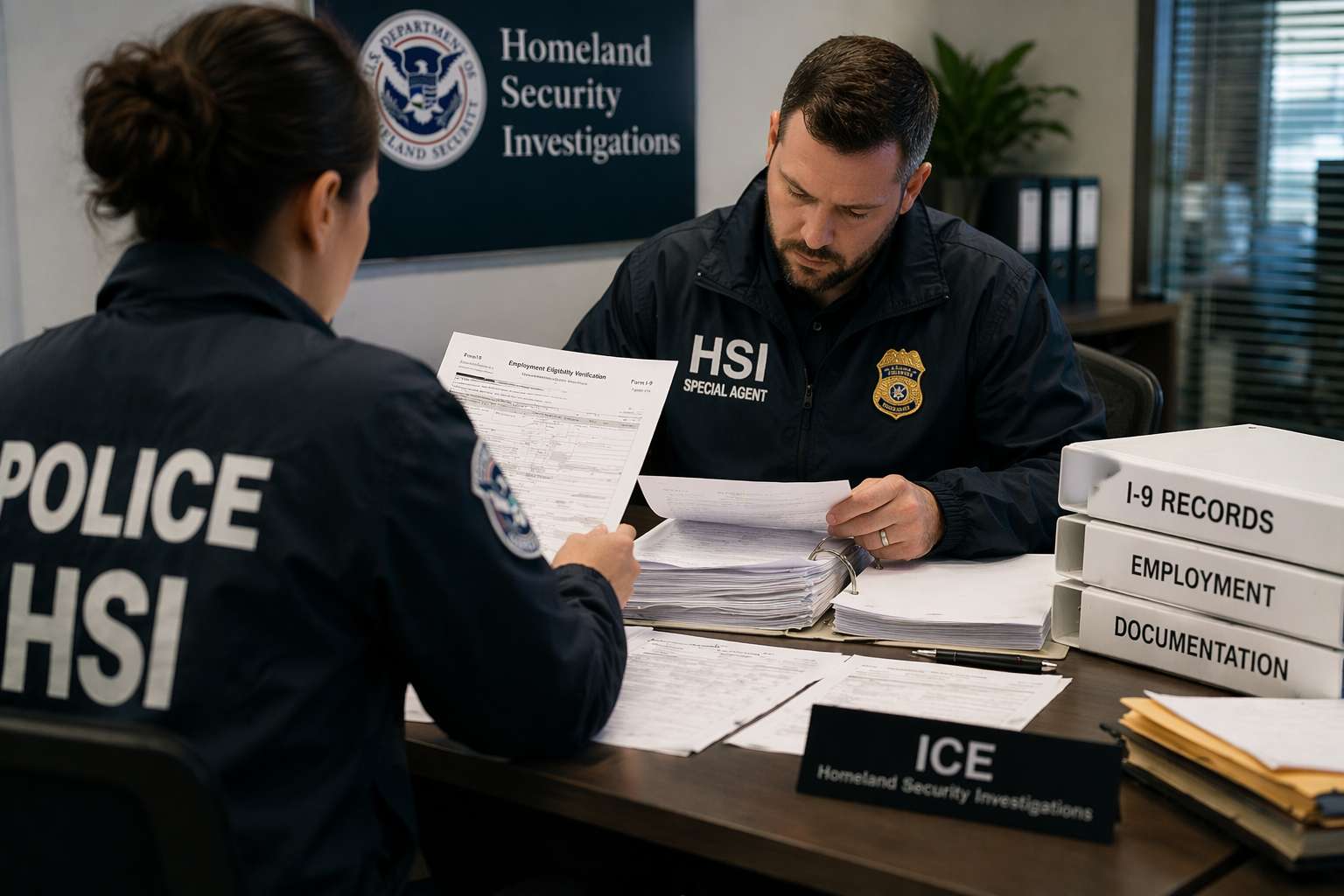
On March 16, 2026, ICE updated its Form I-9 Inspection fact sheet. No Federal Register notice. No press release. No industry alert. No email to the 1.4 million employers who use E-Verify. Nothing.
What changed? Several errors that employers have long been able to correct — within a 10-business-day window — are now immediate fines. No correction period. No second chance.
If you run HR, own a business, or manage compliance for anyone who hires in the United States, this matters to you right now.
What Just Became an Immediate Fine
Here is the list of what ICE reclassified from "technical violation" (correctable) to "substantive violation" (automatic fine) as of March 16:
- Missing dates in Section 1 or Section 2
- Missing employer title in Section 2
- Spanish-language I-9 used outside Puerto Rico
- Missing document details even when a legible photocopy was retained
- Electronic I-9 system failures of any kind under 8 CFR § 274a.2
That last one is the one I want every employer using an electronic I-9 platform to sit with for a moment.
ICE did not just change the rules for human error. They explicitly reclassified electronic system failures as substantive violations. That means your platform — not just how your team uses it — is now a direct compliance liability. If your electronic I-9 system does not meet federal technical requirements, your I-9s may be substantively defective no matter how carefully your staff completed them.
What Federal Law Actually Requires of Your I-9 Platform
Most employers know they have to complete I-9s. Far fewer know that the federal regulations governing electronic I-9 systems are specific, technical, and fully auditable by ICE on 3 days' notice. Here is what 8 CFR § 274a.2 actually requires:
Data integrity. I-9 data must remain complete and accurate through system updates and migrations. No silent failures, no missing fields, no corruption.
Unauthorized change prevention. Role-based access controls must be enforced at the record level. Every person who accesses or changes a record must be uniquely identified. Electronic signatures must be locked after signing.
Tamper-proof audit trail. Every creation, access, correction, and change to an I-9 must be logged — who, what, and exact timestamp — in an audit trail that is itself uneditable, retained as long as the I-9, and survives any system migration.
3-day retrieval. All I-9 records, including full audit histories, must be searchable and reproducible within 3 business days of an ICE Notice of Inspection. If your platform can't export complete records including audit history, that is a problem you want to know about before ICE does.
A documented QA program. This is the requirement I see most consistently missing — even on platforms that are otherwise technically sound. The regulation requires an ongoing inspection and quality assurance program covering both regular evaluations of the system itself and periodic spot checks of stored I-9 records. It must be written, dated, and producible on demand. ICE treats undocumented QA as no QA at all.
To be clear about what a QA program means in practice: you need documented, dated evidence that someone is periodically checking whether the platform is generating forms correctly, storing them without corruption, capturing and retaining electronic signatures, and producing records that are legible and retrievable. And you need spot checks of actual completed I-9s — not just a system health dashboard. Industry best practice is system-level evaluations at least quarterly and record spot checks monthly for new hires, with an annual full sweep. None of this is complicated. All of it needs to be written down.
Ask Your Platform These Questions Today
The March 2026 update makes one thing clear: ICE is no longer treating electronic I-9 systems as a compliance convenience. They are treating them as a compliance obligation — and a potential liability in their own right.
Before your next hire, ask your vendor:
- Does the system maintain a tamper-proof, timestamped audit trail for every record — one that survives updates and migrations?
- Are electronic signatures locked after execution and protected against alteration?
- Can the platform export complete I-9 records including full audit trails within 3 business days?
- Does your company maintain a written, dated QA program covering both system evaluations and periodic record spot checks?
If the answer to any of these is "I'm not sure," find out before ICE does — because the correction window you used to have is gone.
ZipID was built with these federal requirements as design requirements, not afterthoughts. If you want a straight answer on where your current I-9 process stands against the updated rules, we are happy to walk through it. Schedule a demo or contact us — no sales pitch, just the facts.
Janice Kephart is the Founder and CEO of ZipID and one of the most recognized public voices on national security, identity, and border policy in the United States. Former counsel to the 9/11 Commission, she authored the federal identity doctrine underlying today's I-9 compliance framework, including the biometric entry-exit mandate, REAL ID Act, and passport requirements for all travelers. She has testified before Congress 19 times on identity-related issues.
Ready to verify your new hires with confidence?
ZipID completes the entire Form I-9 process in under 8 minutes, fully compliant with 8 CFR § 274a.2.
Schedule a Demo: https://calendly.com/janicek-zipidapp/
Get Started: https://www.zipidapp.com/pricing

Frequently Asked Questions
Is ZipID ICE-compliant I-9 software?
ZipID is designed to satisfy all five federal electronic I-9 system requirements under 8 CFR § 274a.2 — including compliant audit trails, electronic signature protocols, and secure storage standards. It is specifically designed to meet the March 2026 ICE reclassification that elevated common errors to substantive violations.
As of January 2025, I-9 paperwork violations carry fines of $288 to $2,861 per form under 8 CFR § 274a.10(b)(2). Knowingly hiring unauthorized workers carries fines up to $28,619 per worker for repeat offenses. ICE audit rates in 2025 ran at least ten times higher than the prior year.
ZipID is a certified E-Verify Web Services Provider. When the employer signs the I-9, ZipID automatically creates the E-Verify case from within the I-9 workflow and records the result in the "Additional Information" box in Section 2 of the I-9.
What is NIST and why does it matter for I-9 verification?
NIST — the National Institute of Standards and Technology — is the federal agency that sets accuracy benchmarks for biometric identity technologies. For I-9 compliance, NIST validation matters because it provides an independent government-verified measure of whether a facial recognition system is reliable enough to trust. ZipID uses NIST-tested algorithms rated at 99.998% accuracy.
ZipID's 1:1 facial recognition is rated at 99.998% accuracy using NIST-validated algorithms — fewer than 2 mismatches per 100,000 verifications. Liveness detection is built in to confirm the selfie is from a real, present person rather than a photo or deepfake.
OCR — Optical Character Recognition — reads and extracts text from government-issued IDs. ZipID uses AI-powered OCR to instantly capture a new hire's ID data and automatically populate the required Form I-9 fields, eliminating manual entry and typos. The new hire confirms the extracted data before it populates the form.
ZipID uses NIST-validated biometric facial recognition to match a live selfie to the photo on the new hire's government-issued ID. AI-powered OCR extracts and autofills document data. Liveness detection and synthetic image screening run on the selfie capture, confirming a real, present person rather than a photo, replay, or deepfake. E-Verify adds further checks, including Social Security number matching, photo matching for U.S. passports and other select documents, and driver's license data matching in participating states.
Facial authentication is entirely the employer's choice. It confirms that the new hire is who they say they are and that the ID they present matches their live self — especially valuable for remote hires, high-security roles, or industries with elevated identity fraud risk.
How long does it take to complete an I-9 with ZipID?
ZipID completes the entire Form I-9 process — including identity verification, document capture, and E-Verify automation within the ZipID workflow — in under 8 minutes, for both remote and in-person new hires.
ZipID is an I-9 compliance and identity verification platform that combines biometric facial recognition, liveness detection, OCR document capture, and E-Verify to verify new hire identities and complete Form I-9 in under 8 minutes, with an audit trail designed to meet federal electronic I-9 requirements. It is the only I-9 platform built by the person who helped write the federal identity doctrine behind the law.
Who built ZipID?
ZipID was founded by Janice Kephart, former counsel to the 9/11 Commission and a national security identity expert with 25 years of federal and private sector experience, including designing border biometric workflows at MorphoTrak, now Idemia. Kephart authored the federal identity doctrine and biometric entry-exit recommendations underlying today's I-9 compliance framework, and has testified before Congress 19 times.