Welcome to
The Hive
At The Hive, we bring together a dynamic community of HR leaders, compliance experts, technologists, and thinkers who care about getting identity, hiring, and trust right.
Expect practical insights, bold ideas, and real-world stories from across the employment and identity landscape. Not just from ZipID, but from people like you. Because when we swarm together, we build smarter.

Introducing the ZipID E-Verify State Map: How E-Verify Affects You, State by State
A free, interactive map of every state's E-Verify rules, what E-Verify does and does not verify, and how ZipID verifies the person, not just the record.

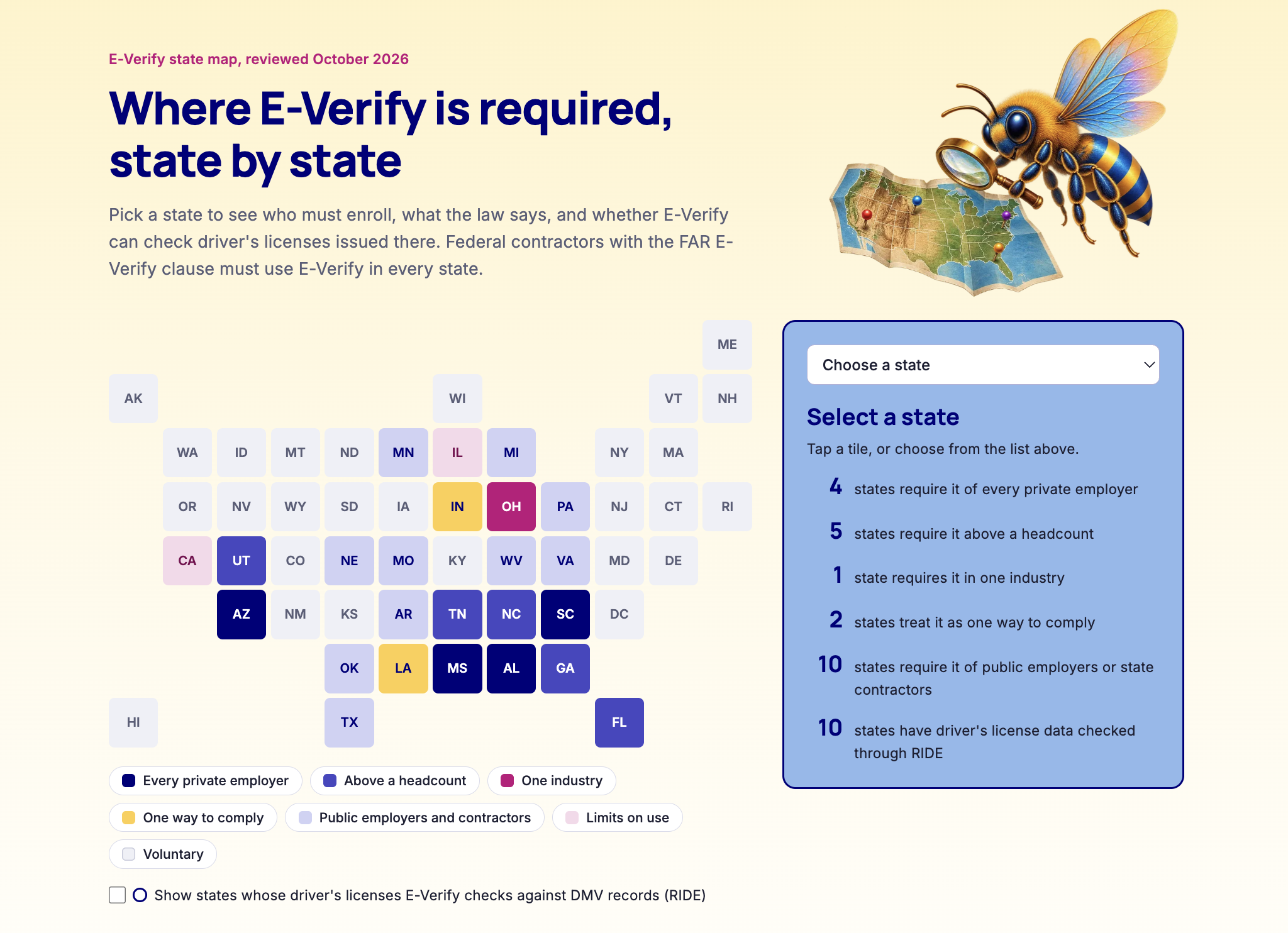
Today we launched a new page on the ZipID website: the E-Verify State Map. It is a free, one stop resource that shows exactly how E-Verify affects an employer, wherever they hire.
Pick any state and the map shows who must enroll, how the state counts employees, the statute behind the rule, and whether E-Verify can check driver's licenses issued there. The same page explains, in plain language, what E-Verify does, what it does not do, and what that leaves for the employer to handle on Form I-9.
What you will find on the page
Every state's E-Verify rules. All 50 states and the District of Columbia, sorted into clear categories: required for every private employer, required above ahead count, required in one industry, required only for public employers and state contractors, E-Verify as one way to comply, states that limit its use, and states where it is voluntary. Private employer mandates cite the state statute directly.
The driver's license gap. Markers on the map show the 10 states whose driver's license data E-Verify actually checks against DMV records.
What E-Verify does and does not do. A side by side look at the records E-Verify checks, the limits of photo matching, and the question it leaves to the employer.
Your obligations if E-Verify applies. A short checklist of what a mandate requires, plus answers to the questions employers ask most.
Why every E-Verify list seems to disagree
Search for "which states require E-Verify" and you will find answers that do not match. Depending on the source, Tennessee's threshold is 6, 35 or 50 employees. Louisiana appears on most lists of mandate states, and it is not one. Indiana's new FAIRNESS Act covers every employer, but it does not require E-Verify; it rewards using it with safe harbor protection.
The lists disagree because they flatten different obligations into one yes or no column. Georgia counts only employees working 35 hours a week or more. North Carolina leaves out workers employed less than nine months a year. Tennessee counts full-time equivalents. Ohio's new requirement applies only to nonresidential construction. The map keeps those distinctions, because they decide whether a aw applies to you.
What E-Verify does, and what it does not
E-Verify compares the information from Form I-9 with Social Security Administration and Department of Homeland Security records. That matters, and in many states it is the law. But it confirms a record, not a person. A real Social Security number borrowed from a relative or bought from a broker can still produce a match.
The identitychecks inside E-Verify are narrower than most employers assume. Driver's license data is checked only for licenses issued by 10 states. Photo matching applies only to U.S. passports, passport cards, Permanent Resident Cards and Employment Authorization Documents, and even then, E-Verify instructs employers not to compare its photo to the employee. The comparison of the person to the document stays with the employer, at Form I-9.
How ZipID augments E-Verify: verifying the person, not just the record
That person-to-document step is where ZipID works. Biometric face matching confirms that the new hire matches the photo on the identity document they present, with liveness and synthetic image screening on the capture. The verified information then flows into Form I-9 and into E-Verify in a single workflow.
ZipID is now a certified E-Verify Web Services Provider, built to the current E-Verify interface standard, ICA v32. That means identity is confirmed before the E-Verify case is ever created, inside the same workflow, with no separate login and no second round of data entry. E-Verify checks the record. ZipID makes sure the record belongs to the person in front of you.
Our mission
ZipID exists to help employers, and the platforms that serve them, navigate Form I-9 so that compliance is generated automatically as part of hiring rather than assembled by hand afterward. That includes the HR platforms, PEOs and background screening firms that carry I-9 work for thousands of employers.
The E-Verify State Map is part of that mission. Knowing which rules apply is the first step. Making sure the identity behind every Form I-9 and every E-Verify case is real is the step that follows, and it is the one ZipID is built to handle.
Explore the map
See how E-Verify affects the states where you hire: https://www.zipidapp.com/e-verify-state-map
To see identity verification and E-Verify in oneworkflow, book a time with our team

Frequently Asked Questions
Is ZipID ICE-compliant I-9 software?
ZipID is designed to satisfy all five federal electronic I-9 system requirements under 8 CFR § 274a.2 — including compliant audit trails, electronic signature protocols, and secure storage standards. It is specifically designed to meet the March 2026 ICE reclassification that elevated common errors to substantive violations.
As of January 2025, I-9 paperwork violations carry fines of $288 to $2,861 per form under 8 CFR § 274a.10(b)(2). Knowingly hiring unauthorized workers carries fines up to $28,619 per worker for repeat offenses. ICE audit rates in 2025 ran at least ten times higher than the prior year.
ZipID is a certified E-Verify Web Services Provider. When the employer signs the I-9, ZipID automatically creates the E-Verify case from within the I-9 workflow and records the result in the "Additional Information" box in Section 2 of the I-9.
What is NIST and why does it matter for I-9 verification?
NIST — the National Institute of Standards and Technology — is the federal agency that sets accuracy benchmarks for biometric identity technologies. For I-9 compliance, NIST validation matters because it provides an independent government-verified measure of whether a facial recognition system is reliable enough to trust. ZipID uses NIST-tested algorithms rated at 99.998% accuracy.
ZipID's 1:1 facial recognition is rated at 99.998% accuracy using NIST-validated algorithms — fewer than 2 mismatches per 100,000 verifications. Liveness detection is built in to confirm the selfie is from a real, present person rather than a photo or deepfake.
OCR — Optical Character Recognition — reads and extracts text from government-issued IDs. ZipID uses AI-powered OCR to instantly capture a new hire's ID data and automatically populate the required Form I-9 fields, eliminating manual entry and typos. The new hire confirms the extracted data before it populates the form.
ZipID uses NIST-validated biometric facial recognition to match a live selfie to the photo on the new hire's government-issued ID. AI-powered OCR extracts and autofills document data. Liveness detection and synthetic image screening run on the selfie capture, confirming a real, present person rather than a photo, replay, or deepfake. E-Verify adds further checks, including Social Security number matching, photo matching for U.S. passports and other select documents, and driver's license data matching in participating states.
Facial authentication is entirely the employer's choice. It confirms that the new hire is who they say they are and that the ID they present matches their live self — especially valuable for remote hires, high-security roles, or industries with elevated identity fraud risk.
How long does it take to complete an I-9 with ZipID?
ZipID completes the entire Form I-9 process — including identity verification, document capture, and E-Verify automation within the ZipID workflow — in under 8 minutes, for both remote and in-person new hires.
ZipID is an I-9 compliance and identity verification platform that combines biometric facial recognition, liveness detection, OCR document capture, and E-Verify to verify new hire identities and complete Form I-9 in under 8 minutes, with an audit trail designed to meet federal electronic I-9 requirements. It is the only I-9 platform built by the person who helped write the federal identity doctrine behind the law.
Who built ZipID?
ZipID was founded by Janice Kephart, former counsel to the 9/11 Commission and a national security identity expert with 25 years of federal and private sector experience, including designing border biometric workflows at MorphoTrak, now Idemia. Kephart authored the federal identity doctrine and biometric entry-exit recommendations underlying today's I-9 compliance framework, and has testified before Congress 19 times.