Welcome to
The Hive
At The Hive, we bring together a dynamic community of HR leaders, compliance experts, technologists, and thinkers who care about getting identity, hiring, and trust right.
Expect practical insights, bold ideas, and real-world stories from across the employment and identity landscape. Not just from ZipID, but from people like you. Because when we swarm together, we build smarter.

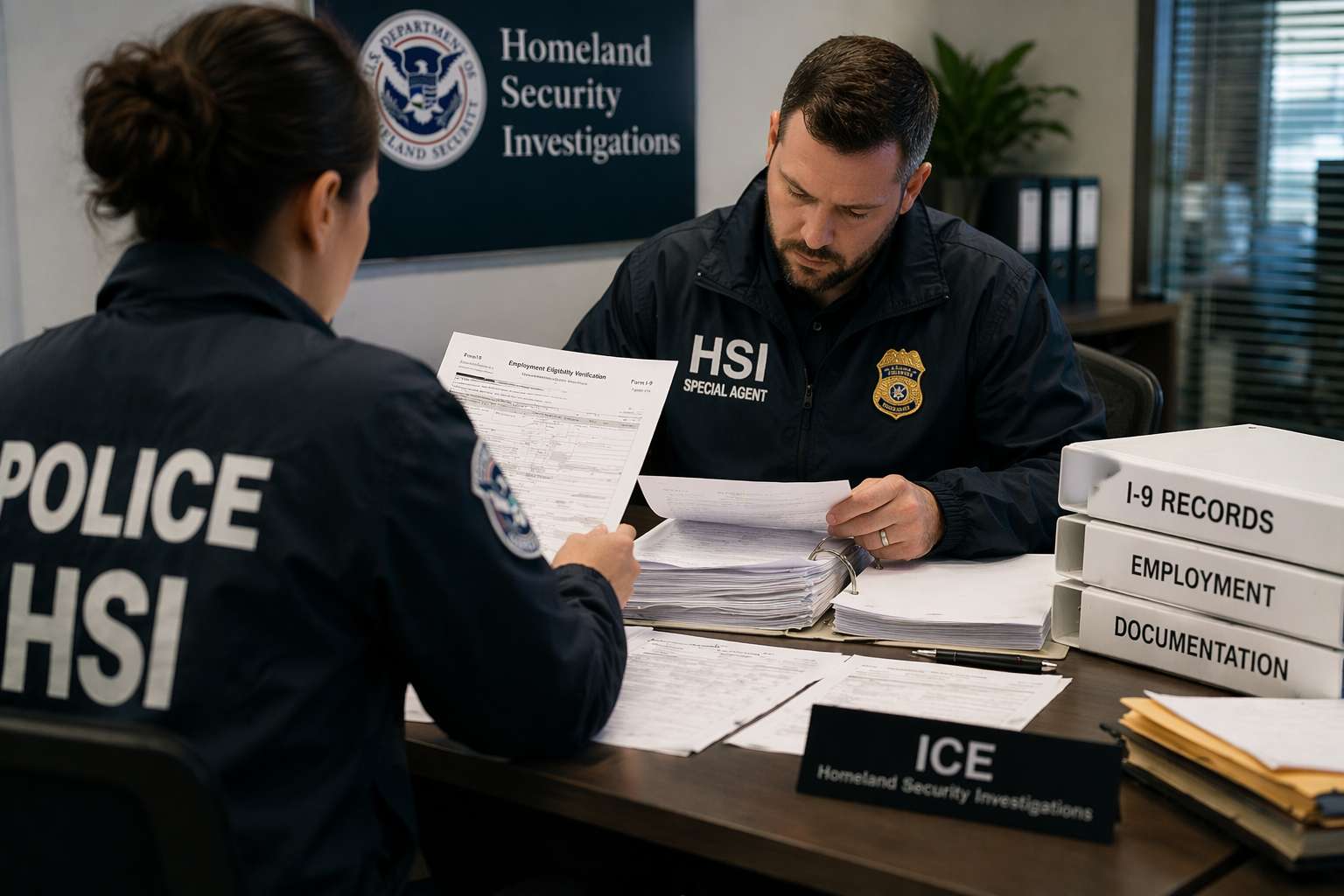
ICE Executes Federal Search Warrant at Buckeye Fire Equipment — What It Means for Identity Verification & Employer Risk
Federal agents just arrested 30 people at a U.S. company for identity fraud. Learn how to protect your business before it’s too late.


ICE Executes Federal Search Warrant at Buckeye Fire Equipment — What It Means for Identity Verification & Employer Risk
According to the ICE press release:
- The operation targeted “serious allegations of aggravated identity theft and potential federal crimes.” ICE
- Thirty individuals were arrested onsite in relation to the initial investigation. ICE
- Multiple federal, state, and local agencies participated, including ICE Enforcement & Removal Operations, FBI, U.S. Marshals, IRS Criminal Investigations, Social Security Administration OIG, DEA, ATF, Customs, and local law enforcement. ICE
- HSI leadership emphasized that “identity fraud is not a victimless crime — it fuels a range of criminal activity and puts innocent people at risk.” ICE
Below is my take on the implications for identity verification, HR/compliance teams, and organizations that deal with employment eligibility risk.
Key Themes & Implications for Verification Stakeholders
1. Identity Fraud & Employment Are Front and Center
This case reinforces a major trend: identity theft is increasingly tied to employment and HR systems. Employing or contracting individuals using stolen or synthetic identities is a vector exploited by criminals. The fact that ICE targeted a functioning business underscores that legitimate employers can become inadvertent nodes in these schemes.
This means stronger due diligence and suspicion of anomalous patterns are crucial.
2. Enforcement Focus Is Broader than Just “Immigration”
While ICE/Homeland Security is involved, this operation is not purely about immigration enforcement — it is about financial crimes, identity systems, and cross-agency collaboration. The roster of participating agencies (IRS, SSA OIG, FBI) signals the integrated approach to fraud, tax, benefits misuse, and identity systems. ICE
Thus, organizations should see this not as a niche “immigration compliance” risk, but as part of a broader identity and financial risk ecosystem.
3. Employers Can Be Targets of Investigation
Because the warrant was executed at the workplace, it’s clear that companies—even those that are not alleged to be criminal enterprises—can be places of investigative action when identity fraud is alleged. This raises a few practical cautions:
- Maintain clear documentation of your identity verification / onboarding processes (what was checked, when, by whom).
- Ensure that your HR, Legal, and Compliance teams know how to respond if authorities approach your site.
- Ensure you are using the most up-to-date, reliable verification tools and fraud detection capabilities.
4. Patterns and Red Flags Must Be Monitored
Given that 30 arrests were made onsite, whatever identity fraud scheme was being pursued likely involved group coordination or systematic misuse. This suggests that fraudsters may organize around:
- Fake / stolen documents (SSNs, birth records)
- Synthetic identities (mixing real and fake data)
- Coordinated fraud rings that target multiple employers or industries
Verification systems and HR teams should therefore look for red flags like multiple hires with similar address or SSN patterns, unusual background check anomalies, discrepancies in documentation history, or multiple “new hires” in a short span with overlapping characteristics.
5. Collaboration & Information Sharing Will Be Key
HSI’s statement calls for tips from the public and stresses interagency cooperation. ICE This suggests that success in detecting identity fraud depends on:
- Cross-sector intelligence sharing
- Data partnerships (e.g. with government or credit bureaus)
- Alerting and reporting mechanisms when suspicious documents/identities surface
6. Reputational & Legal Risk for Employers
Even if an employer is not complicit, being the locus of a federal search warrant can attract serious reputational harm. Employers should:
- Have a response plan (legal, PR) in case their premises or systems are searched
- Conduct internal audits periodically of identity / I-9 / onboarding practices
- Train staff (especially compliance / HR) on dealing with law enforcement requests or subpoenas
About Buckeye Fire Equipment
- Business: U.S. manufacturer of fire-protection products (portable & wheeled fire extinguishers, foam agents/hardware, kitchen suppression systems, plus industrial gas & flame detection). Buckeye Fire Equipment
- Founded: 1968 (“American Made Since 1968”). Buckeye Fire Equipment
- Ownership: Privately owned/operated. Buckeye Fire Equipment
- HQ/Address: 110 Kings Road, Kings Mountain, NC 28086 (near Charlotte). Buckeye Fire Equipment
- Quality/Certs: Products tested by UL/ULC, Factory Mutual, ASME; company lists ISO 9001:2015 certification.
What they make (examples)
- Extinguishers: Dry chemical, CO₂, Halotron, water/mist, high-flow/heavy-duty, offshore variants. Buckeye Fire Equipment
- Foam concentrates & hardware: Bladder tanks, eductors, monitors, hi-expansion generators, foam carts; literature highlights PFOS/PFOA-free formulations. Buckeye Fire Equipment+1
- Kitchen suppression: “Kitchen Mister” restaurant system. Buckeye Fire Equipment
- Gas/flame detection: Marketed via a dedicated site (linked from their main site). Buckeye Fire Equipment
Janice Kephart is the Founder and CEO of ZipID and one of the most recognized public voices on national security, identity, and border policy in the United States. Former counsel to the 9/11 Commission, she authored the federal identity doctrine underlying today's I-9 compliance framework, including the biometric entry-exit mandate, REAL ID Act, and passport requirements for all travelers. She has testified before Congress 19 times on identity-related issues.
Ready to verify your new hires with confidence?
ZipID completes the entire Form I-9 process in under 8 minutes, fully compliant with 8 CFR § 274a.2.
Schedule a Demo: https://calendly.com/janicek-zipidapp/
Get Started: https://www.zipidapp.com/pricing

Frequently Asked Questions
Is ZipID ICE-compliant I-9 software?
ZipID is designed to satisfy all five federal electronic I-9 system requirements under 8 CFR § 274a.2 — including compliant audit trails, electronic signature protocols, and secure storage standards. It is specifically designed to meet the March 2026 ICE reclassification that elevated common errors to substantive violations.
As of January 2025, I-9 paperwork violations carry fines of $288 to $2,861 per form under 8 CFR § 274a.10(b)(2). Knowingly hiring unauthorized workers carries fines up to $28,619 per worker for repeat offenses. ICE audit rates in 2025 ran at least ten times higher than the prior year.
ZipID is a certified E-Verify Web Services Provider. When the employer signs the I-9, ZipID automatically creates the E-Verify case from within the I-9 workflow and records the result in the "Additional Information" box in Section 2 of the I-9.
What is NIST and why does it matter for I-9 verification?
NIST — the National Institute of Standards and Technology — is the federal agency that sets accuracy benchmarks for biometric identity technologies. For I-9 compliance, NIST validation matters because it provides an independent government-verified measure of whether a facial recognition system is reliable enough to trust. ZipID uses NIST-tested algorithms rated at 99.998% accuracy.
ZipID's 1:1 facial recognition is rated at 99.998% accuracy using NIST-validated algorithms — fewer than 2 mismatches per 100,000 verifications. Liveness detection is built in to confirm the selfie is from a real, present person rather than a photo or deepfake.
OCR — Optical Character Recognition — reads and extracts text from government-issued IDs. ZipID uses AI-powered OCR to instantly capture a new hire's ID data and automatically populate the required Form I-9 fields, eliminating manual entry and typos. The new hire confirms the extracted data before it populates the form.
ZipID uses NIST-validated biometric facial recognition to match a live selfie to the photo on the new hire's government-issued ID. AI-powered OCR extracts and autofills document data. Liveness detection and synthetic image screening run on the selfie capture, confirming a real, present person rather than a photo, replay, or deepfake. E-Verify adds further checks, including Social Security number matching, photo matching for U.S. passports and other select documents, and driver's license data matching in participating states.
Facial authentication is entirely the employer's choice. It confirms that the new hire is who they say they are and that the ID they present matches their live self — especially valuable for remote hires, high-security roles, or industries with elevated identity fraud risk.
How long does it take to complete an I-9 with ZipID?
ZipID completes the entire Form I-9 process — including identity verification, document capture, and E-Verify automation within the ZipID workflow — in under 8 minutes, for both remote and in-person new hires.
ZipID is an I-9 compliance and identity verification platform that combines biometric facial recognition, liveness detection, OCR document capture, and E-Verify to verify new hire identities and complete Form I-9 in under 8 minutes, with an audit trail designed to meet federal electronic I-9 requirements. It is the only I-9 platform built by the person who helped write the federal identity doctrine behind the law.
Who built ZipID?
ZipID was founded by Janice Kephart, former counsel to the 9/11 Commission and a national security identity expert with 25 years of federal and private sector experience, including designing border biometric workflows at MorphoTrak, now Idemia. Kephart authored the federal identity doctrine and biometric entry-exit recommendations underlying today's I-9 compliance framework, and has testified before Congress 19 times.